Halfway through the 16th Century, Saint John of the Cross was kidnapped by members of his own Carmelite Order and imprisoned in a cold, dark, and damp prison cell in the basement of their monastery in Toledo, Spain. His captors were the institutional leaders of the Carmelite Order who stood in opposition to the reforms that John was calling for in their Order. Together with Teresa of Avila, John sought to return the Carmelite Community to itself, letting go of privilege to take on poverty and surrendering influence for indifference. The reforms that Teresa and John proposed were a threat to their institutional leaders and, as a result, John was held captive for nine months.
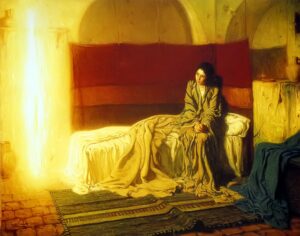
In his cold, dark, and damp prison cell, a vision began to emerge for John. He saw a warm and bright fire of divine love being kindled. The glow from this fire was, for most of the day, the only light in the room. One day John began to see a log, representing himself, being placed in this fire of divine love, and immediately the flames wrapped around the log, so as to welcome and embrace it. The fire then began to consume the log. First, the exterior bark began to flake off and fall to the core of the fire. Then, the interior bark was seared and charred before it, too, was consumed. Gradually, the entire log, through its core, was broken down and consumed as it became one with the fire.
Although partially conscious of the gradual process of being consumed by divine love, John’s experience of this vision and what it represented in his life was painful. He would later describe this experience, of being stripped of everything but divine love, as his Dark Night of the Soul. Each stage of letting go was hard and painful. He describes the flaking off of the exterior bark as letting go of comfort and the things he had come to enjoy– watching the sun rise, enjoying the company of friends, and being able to read. The searing and charring of the interior bark was even harder as he surrendered his desires for importance, revenge, and needing to be right. Finally, as the flames consumed the core of his being, he was freed from any attachment, impulse, or desire that would create a barrier between the core of his heart and love itself. Though a hard and painful experience, John realized that in his dark night of captivity, he had been consumed by divine love. This love fueled reforms in his Order that continue today.
Several hundred years later, a similar visionary reformer was kidnapped and held in a cold, dark, and damp prison cell, this time in Pretoria, South Africa. Nelson Mandela was imprisoned because he was advocating for equality and an end to the racist system of apartheid. The institutional leaders of the country responded by holding him in a prison cell for 10,052 days from 1962 to 1990.
Like John of the Cross, Mandela was stripped of comforts and freedoms. He was deprived of justice and dignity. He suffered deep loss, even losing his mother and his son without being able to say goodbye or mourne with his family. He had to face the potential loss, too, of ever seeing his dream for South Africa become real. And yet, at his release from prison, Mandela wrote, “As I walked out the door toward the gate that would lead to my freedom, I knew if I didn’t leave my bitterness and hatred behind, I’d still be in prison.” Even in the darkness of captivity, Nelson Mandela was consumed by divine love and as a result he went on to build a “rainbow nation” in which people of each tribe and color were invited to a place at the table of leadership and opportunity.
One year after Mandela was imprisoned, a similar visionary reformer was arrested and held captive, locked in a cold, dark, and damp prison cell in Birmingham, Alabama. The Rev. Dr. Martin Luther King, Jr. had been marching without a permit, kindling the Civil Rights Movement that sought to bring about equality and justice for all people living in the United States. The institutional leaders of the country that he loved saw him as a threat and, as a result, they sought to imprison him and his dream.
From this Birmingham jail cell, King wrote what has become a foundational letter that continues to inspire and shape justice-organizing to this day. In this letter, he said that, “injustice anywhere is a threat to justice everywhere.” He also asked the question, as if it were weighing on his own conscience, “Are we to be extremists of hate or are we to be extremists of love?” Upon his release, King doubled-down on love and shepherded a nonviolent movement that fought injustice with justice and fought hate with love, for he too had been consumed by the fire of divine love.
John of the Cross, Nelson Mandela, and Rev. Dr. Martin Luther King, Jr. are just three examples, but their life stories tell us, by concrete experience, that when we are in cold, dark, and damp places, powerful transformations are possible. When we are in these dark nights, God shows up with us, kindling a warm and bright flame, that, if we let it, will consume us and take away our clinging to comfort, liberate us from needing to be right or in control, and set us free to become one with love itself.
Perhaps you are in one of these places, or maybe someone you love and care for is in one, or maybe you feel like we are all in a cold, dark, and damp place. Let’s learn from these visionary reformers. Let’s not be afraid of the dark or of where we are, but seek to see and be set free by God’s consuming fire of divine love. It may not be easy, comfortable, or fun, but if we allow this flame to come close, we too will be transformed, and we too will be consumed by love itself.
~Josh